
SYRIZA, skimming past Ithaca
Since 2009-10, Greece has been going through a political and economic war — a national and social conflict of immense proportions. A war whose outcome is still far from settled; yet its current phase came to a close after five years, with a crushing —and sadly definitive— defeat for the side of the people that had risen up against the system. The bailout memoranda were enforced, the country was turned —with its own institutional consent— into a debt colony, and worst of all, a significant part of the popular anti-austerity majority came to accept, under the guidance of its own leadership, that there was, in fact, no alternative. In short, popular radicalism and the Left —barefoot battalions in total darkness— fell apart, like the Incredible Army of Brancaleone.
What exactly happened? Why did it happen this way? Could it have turned out differently? And what now? These, I believe, are the questions this Ιssue of Tetradia sets out to address. In my view, the decisive issue of the entire period lay in the Greek Left’s —and especially SYRIZA’s— inability to conceive and give political substance to a notion of radical responsibility. That is, a kind of political orientation and practice that would have enabled the Greek people to resist the imposition of the bailout memoranda by actively and positively taking responsibility for their own fate — transforming resistance into a genuine alternative path out of the memoranda and the crisis.
I understand that the demand to combine radicalism with responsibility may sound paradoxical.
Responsibility, as a matter of personal morality and prudent self-management, has long been associated with conservatism and the Right. Radicalism, on the other hand —implying, in one way or another, a challenge to the established order— evokes disruption, upheaval, risk, and uncertainty: elements not easily reconciled with the caution and prudence that responsibility implies.[1] And yet, the slogan of the ‘Indignant’ protesters in Syntagma Square —“to take our fate into our own hands”— was nothing less than a double, two-edged call: both for radical change and for the assumption of responsibility.
Taking up the baton of ‘responsibility’ from the Indignants
Much could be said about how SYRIZA positioned itself in relation to the Indignants when the wave of popular outrage erupted in May 2011. But once the limits and weaknesses of the square movement had become clear, what allowed the then-small and marginal SYRIZA to take up the baton of representing popular radicalism was a statement by Alexis Tsipras, then leader of SYRIZA, before the 2012 elections: that his party was willing to take on the responsibility of governing.
I do not disregard the importance of other factors — such as SYRIZA’s programmatic shift between 2009 and 2011, which also played a significant role in its political maturation. Or its presence on multiple fronts, and above all, its stance toward the Indignants — far more tolerant and open than that of the Communist Party (KKE) or other leftist organizations. But let’s not fool ourselves: we all know that the barrier between the Left and the people was broken by Tsipras’s statement. That was the decisive moment. This is something today’s critics of Tsipras from the Left conveniently forget. But there is no doubt that, without that statement, SYRIZA would never —under any circumstances— have entered the orbit of representing the growing anti-austerity sentiment that eventually brought it to power. And that happened because this unexpected declaration —especially coming from a radical left party— touched on something central in the popular psyche.[2]
Most discussions about that period have failed to adequately illuminate this point. For a left-wing leader to declare that he was ready to take on the governance of the country —on the basis of a clearly anti-austerity agenda, but without any socialist prerequisites or revolutionary footnotes— did not merely offer a practical answer to the question of how to rid the country of the pro-memorandum governments. It also sent the public an implicit but powerful signal about the credibility of Alexis Tsipras himself, and by extension, of SYRIZA. A signal that neither the Communist Party (KKE), nor ANTARSYA, nor the other far-left groups — nor even the majority of SYRIZA’s own cadre — were able to perceive. It revealed a willingness to take responsibility for the struggle without the obsessions of an ideologically fixated, marginal, and ultimately irresponsible radicalism.
It was a gesture of discreet yet clear distancing from an ideological–imaginary anti-capitalism —which, whether right or wrong, was and remains far removed from the outlook of the popular majority— and from a brand of elitist progressivism that goes hand in hand with an equally elitist anti-nationalism. These are the two faces of the anti-populist stance that has dominated the post-communist Left (beyond the KKE) for the past several decades. Tsipras’s partial, yet significant, detachment from these hallmarks of the marginal, post-PASOK radical Left gave hope to a large segment of the people —people who had taken to the streets out of necessity, not ideology— that this young leader might be willing to shed his ideological trappings and assume the responsibility of representing the entire afflicted society in the face of the historical challenges it confronted.
But here ends the idyllic part of the story — and the thriller begins. Because the people who believed in Tsipras thought that the de-ideologization of his political stance was a sign of maturity, not mere pragmatism — a sign of SYRIZA’s resolve and capacity to take on shared responsibility in the face of the great confrontation that lay ahead. But as it turned out, neither SYRIZA as a party, nor Alexis Tsipras personally, possessed the intellectual and emotional wherewithal to distinguish between realism and pragmatism, between a radical mindset and one of defeatism. Let us now see how this failure took shape through the actual course of events.
So Much Socialism, So Little Revolution
The first challenge was for SYRIZA to clarify the nature of the situation it was facing — and how it intended to deal with it. Stuck in an economistic, quasi-Marxist scholasticism, SYRIZA’s ideological strategists spent time —around 2012— pondering how deep the crisis really was: Could it be overcome within capitalism, through intra-capitalist reforms? Or were they facing a profound crisis of capitalism itself, one that called for its transcendence? In other words, they pulled from the dustbins of history the classic dilemma: reform or revolution?
That is Marxism for Classics Illustrated! The history of the 20th century has made it clear that any crisis —whether deep or shallow— can equally become the occasion either for restructuring within the framework of capitalism, or for its transcendence. Whether one or the other path is taken does not depend on the ‘objective’ economic field or the nature of the crisis, but on the ‘subjective’ factor: the degree and quality of society’s radicalization and political empowerment in relation to its adversaries and to the state — in other words, on politics itself.
That means that SYRIZA failed to see —or was unable or unwilling to see— what was obvious to the Indignants: that the crucial knot from which the thread of social and political transformation had to be pulled was not the broad (and vague) dilemma of reforming capitalism versus launching an anti-capitalist revolution. Rather, it was the overthrow of the specific political system that had driven the country into crisis. The key issue was not simply how to amend the extreme austerity measures being implemented, but how to dismantle the political regime as a whole.
It is worth noting that the crisis of the Greek political system had already become a catalyst for the radicalization of large segments of the population well before the first bailout memorandum — at least since the wildfires of 2007 and the December 2008 riots. The chant “Let it burn, let it burn – the whorehouse, the Parliament!” was heard en masse during the early demonstrations of May 2010 — a time when most Greeks had yet to fully grasp what the memorandum actually was.[3] And it was no coincidence that a year later, the ‘positive’ alternative expressed in Syntagma Square did not consist in some different economic policy, but rather in a demand for justice and democracy — ‘direct’ or ‘real’.[4] Nor was it accidental that the Indignants’ rage was directed at the mainstream media and journalists, as well as at the political parties and trade unions — all of which, regardless of political affiliation (Right, Left, etc.), were seen by the people of the square as integral parts of the political system.
However, the idea of such a frontal confrontation with the political system was beyond the grasp of SYRIZA —as well as of the other left-wing organizations. For such a stance would have first required a radical process of introspection and self-criticism, which they were neither willing nor able to undertake. They would have had to ask themselves to what extent the Left —not only the conventional branches of the Communist Party (KKE) and the KKE Interior, but also the so-called ‘revolutionary’ ones— had also become, through its involvement in trade union structures and various ideological mechanisms, a part of the dominant political system.
Thus, the idea of confronting the political system was rejected within the Left — from one side as too extreme, from the other as too moderate. Some saw it as excessively radical and vague: (What does it mean to overthrow the political system? And what would replace it, if not a socialist revolution? And is society really ready for such things?) Others viewed it as too moderate and ultimately misleading: (It did not directly challenge the capitalist system as a whole, but merely the way it was governed — thereby, in their view, letting capitalism off the hook by focusing only on one faction of the ruling class: the oligarchy.) With both sides sharing a common strategic horizon —an idealized and imaginary overthrow of capitalism— they ended up rejecting the possibility of an immediate democratic constitutional revolution: a revolution for justice and democracy. Instead, they chose to focus on a defensive stance, aiming merely to resist austerity within the field of economic policy, leaving the political system itself untouched.
In reality, both sides within the party of SYRIZA —the ‘right’ as well as the ‘left’— approached the question of strategy in terms of sequential stages. The only difference was that the ‘left’ hoped for a faster pace, while the ‘right’ deferred the next steps to a distant (i.e. non-existent) future. This, in short, was the dialectic of SYRIZA’s internal tendencies: the articulation of an unrealistic radicalism —capable only of denunciations and far-fetched demands, utterly incapable of formulating a positive stance of rupture and transformation under the given conditions— and a managerial pragmatism that saw no space for a real break, either with the domestic political system and the oligarchy or —even less so— with the powers abroad.
SYRIZA-Jekyll and SYRIZA-Hyde
From very early on —at least since SYRIZA became the official opposition in the summer of 2012— Alexis Tsipras and his close inner circle had already made their strategic choice.
For them, assuming responsibility was never meant to lead to real confrontation.
It meant scaling down the people’s anti-austerity aspirations and channeling them into a framework that would be manageable — both in terms of the domestic political establishment and the overarching strategy of Greece’s international creditors.
From that point on, the dialectic of SYRIZA’s internal strife was defined by a continuous tension —but also a practical alignment— between its two prevailing tendencies: on the one hand, the ‘responsible’ pragmatism of the party leadership, and on the other, the denunciatory and assertive radicalism of the internal left opposition. What held them together was a shared expectation of a ‘left government’ and a rhetorical convergence — so long as rhetoric could take precedence over action. And because for both tendencies the question of political action was posed in terms of party or governmental top-down mechanisms —rather than in terms of shifting political power toward society— the two managed to coexist without serious friction up until the referendum of July 5, 2015. In doing so, both tendencies —each in its own way— contributed to the disorientation, disempowerment, and eventual paralysis of the popular anti-austerity radicalism of 2011-12 and of the social and labor struggles of the years that followed.
The damage began right after SYRIZA’s electoral triumph in the summer of 2012. Instead of using its new position as the main opposition party to build on the momentum —by helping to strengthen and multiply the spontaneous pockets of popular disobedience— it chose to do exactly the opposite: to pacify the rebellious public through the so-called ‘ripe fruit’ strategy, nurturing the illusion that no serious action was needed, since the tripartite government (New Democracy, PASOK, and DIMAR) would supposedly collapse within a few months.
One of the first casualties of this strategy was the resistance to the ‘emergency property tax’ (the so-called ‘haratsi’). At first, SYRIZA —and Alexis Tsipras personally— appeared to embrace the ‘I Don’t Pay’ stance. Very soon, however, a mysterious silence fell over the entire issue, leaving both the individuals who had refused to pay and the grassroots groups supporting them politically and practically exposed. This was the first strong indication of where Tsipras was headed. And I would even dare to say that it was there, in that deep silence, that the most decisive battle for expanding popular radicalism into broader social strata was lost. If SYRIZA had truly wanted to lead a broad-based movement for change, then at that very moment —in the fall of 2012— it should have drafted an alternative taxation plan, explicitly opposed to the memorandum’s policies. In the name of such a plan, the party could have called on the people to engage in widespread civil disobedience — not just against the ‘haratsi‘, but against the entire tax regime.
A refusal to pay, not blindly or anarchically as in the early ‘I Don’t Pay’ movement, but deliberately — in the name of a coherent, alternative taxation proposal that would have turned the movement’s stance from reactive and defiant to affirmative and responsible.[5]
This was followed in December 2012 by SYRIZA’s Nationwide Conference, where a crucial decision had to be made: would SYRIZA become a party open to society and to popular radicalism, or would it remain the property of the small groups that had created it? The latter path was chosen — under the left-minded argument that the party should not open itself indiscriminately to active citizens lacking militant credentials and revolutionary references. It had to remain in the hands of the consistent revolutionaries who knew how to steer the ship unswervingly toward socialism! Those who later lament Alexis Tsipras’s “monarchy” should know that it was merely the natural consequence of the closed and oligarchic party structure imposed at that very conference.
We could say much more about the years between 2012 and 2015 — years that might have seen the emergence of a broad-based movement of civic disobedience and democratic renewal. Instead, that potential was steadily undermined. There were real episodes of mass resistance: the strikes by teachers, doctors, and hospital workers; the self-managed occupation of ERT (the public broadcaster); the widespread anger against the property tax called ENFIA (the permanent version of the earlier “haratsi”). These moments pointed to a possible path of collective refusal and political self-organization. But rather than investing in this grassroots energy, SYRIZA turned elsewhere. What it chose instead was a strategy of electoral ascent — one framed in terms of traditional left-right partisanship, under the banner “First Time Left.” In doing so, the party essentially appropriated, in narrow partisan terms, a much broader public outcry against the political system and the memoranda. Rather than organizing the so called ‘middle classes’ — the actual social majority — around a project of political rupture and institutional transformation,
SYRIZA promised a loosening of austerity in favor of the most vulnerable, based on Keynesian redistribution — but without any actual resources. Or rather, with resources supposedly to be handed over by our adversaries, so we could use them to defeat them! The so-called “Thessaloniki Program” was not a plan of confrontation, but one of concession. The subsequent “negotiation” was not a strategy for rupture, but a desperate appeal for leniency — one that the country’s creditors flatly rejected. And rightly so, from their point of view: for them, the issue was not simply recovering their loans, but punishing the disobedient Greeks and sending a message to the rest of the European South.
To my mind, it is clear that the war was not lost during the ‘negotiation’ with the ‘external’ players (the creditors, the EU), but much earlier — when SYRIZA’s leadership made a conscious decision not to confront the domestic political system (i.e., the ruling Greek oligarchy). And this happened not only because of whatever self-serving intentions or calculations one might reasonably suppose, but above all because the party leadership was incapable of grasping and handling the tension between radicalism and responsibility — unless through the ideological binary of ‘anti-capitalist rupture’ versus ‘managerial adaptation’. Given that the first was out of the question, they opted for the second — first and foremost in relation to the internal political system, and only secondarily in relation to the international balance of forces. It was this inability —on the part of Alexis Tsipras, a tragic figure emblematic of the post-1974 Greek Left— that cost everything. The rest —the party’s left-wing opposition and so on— were simply left dangling, incapable of engaging with the real problem, contenting themselves with lamenting, denouncing, and insisting on the ‘faithful’ application of the strategy of the good old SYRIZA… just for the sake of it!
From Anti-Oedipus to Telemachus — how long is the road?
In May 2016, the book The Telemachus Complex by psychoanalyst Massimo Recalcati was published in Greek. It had originally come out in Italian in 2013.[6] This short volume, which explores the symbolic shrinking of the paternal figure in modern societies and the resulting inability of contemporary human beings to assume responsibility for their own deeper desire —whether personal or collective— seems to capture, almost photographically, the failure of Greek society in general, and of the Left in particular, to view the necessary rupture with the existing order in terms of responsibility and emancipation, rather than merely denunciation, protest, and destruction.
Recalcati analyzes four “Types of Child” that represent distinct psychic and spiritual attitudes, starting from the contestation of May ’68 and reaching all the way to the present day:
a) The Child-as-Oedipus corresponds to the well-known generation gap and is the dominant representative of youth and rebellion up until the late 1970s — the very period in which the basic types of the Greek Left were being formed after the fall of the 1967-74 dictatorship. He expresses the conflict with tradition, with rules, with the Law. Desire emerges in opposition to reality, in a clash between imagination and the given order, between the ‘new’ and the ‘old’.
b) The Anti-Oedipal Child emerges in the following decades, hoping to bypass the Oedipal drama altogether. He skips the confrontation with the father–Law and simply unleashes his desire — a desire he can no longer experience or articulate except through the displaced terms of the repressed symbolic father: as a drive for money and power, as a worship of consumption and domination stripped of any legitimizing symbolic frame. A key moment in the formation of this psychic type, according to Recalcati, was the 1972 publication of Gilles Deleuze and Félix Guattari’s book L’Anti-Œdipe: Capitalisme et schizophrénie — “the strongest possible criticism of psychoanalytic practice and theory from the left” (Recalcati, English edition, epub format, 90).
c) Next comes the Child-as-Narcissus — a characteristic figure of the decades leading up to the outbreak of the 2008 economic crisis. This is the era in which the Father has completely evaporated: “the balcony of St Peter’s stands empty and the memory of the secretary general of the Communist Party has vanished (Nanni Moretti), and Ideals seemed to have all been defaced (Pasolini)” (ibid 94). There is neither desire nor subjectivity, but only a viscous mirroring of the ‘Ego’ in a pool of consumer objects. There is no longer any conflict, only a “confusion between generations” and “the cult of an individual happiness without ties to the Other” (ibid. 86).
d) According to Recalcati, the great crisis that shook the West —along with the transformations that followed— brings a new protagonist to the fore: the Child-as-Telemachus, who stands up for his inheritance against the suitors and sets out on a journey to find his father, seeking the Law as a form of justice. Telemachus’ desire is not a desire “for an Other world, a utopian reality that does not exist or an ideal city that would be impossible to reach. Telemachus demands justice now! His indignation refuses the current situation, not in the name of an impossible ideal but in the Name of the Father” (ibid, 100). Yet, as Recalcati notes, not just any father — but Odysseus: the man who, when he had to introduce himself in the Iliad, did not do so as king of Ithaca but as “the father of Telemachus;” a man defined by “the limitless responsibility of a father rather than the power of his Name;” and who, for the sake of that responsibility, renounces “the thrill of roaming and the immortality of the eternal” demonstrating how “the eternal is in the world, it is here, it lies in the bond with those we love” (ibid., 102-104).
I’m not sure whether the relevance of all this to Greece’s recent ordeal is immediately obvious. The crisis struck a society made up largely of Anti-Oedipal and Narcissistic characters. And amidst the turmoil of collapse and disintegration, its defense was taken up by a Left whose psychic and spiritual core was still shaped by the figure of Oedipus — incapable of assuming any real responsibility beyond the fantasy of a purely imaginary clash with power. But this is not what the country truly needed. Like Telemachus, we are called to reorganize ourselves and shoulder the burden of our inheritance — not to build some utopian ‘new society’, but to restore justice and democracy, here and now. Only on this foundation can the prospect of a broader and deeper political and social transformation truly open up — if and when society itself chooses to pursue it.
Υπ’ αυτή την έννοια δικαιολογώ κατ’ αρχήν την ενστικτώδη ανάγκη του Αλ. Τσίπρα να ξεφύγει από το ‘αριστεροχώρι’, προκειμένου να σταθεί στο ύψος της κοινής συλλογικής ευθύνης με όρους πραγματικούς και όχι φαντασιακούς. Μόνο που αποδείχθηκε, δυστυχώς, πολύ λίγος γι’ αυτό το ιστορικό καθήκον — όχι σαν ψυχολογικός χαρακτήρας, αλλά σαν τύπος αριστερού. Και μαζί με αυτόν αποδείχθηκαν εξ ίσου λίγοι και όλοι αυτοί που τον περιέβαλλαν. Αντί να οδηγήσουν την Αριστερά και τη χώρα στην απαιτούμενη υπέρβαση, ξέφυγαν από το πρόβλημα σαν λιποτάκτες. Νόμισαν ότι θα μπορούσαν να γλυτώσουν τη μοίρα του Οιδίποδα αν προσαρμοζόντουσαν στον γνώριμό τους ρόλο του Αντι-Οιδίποδα (του οποίου το εκσυγχρονιστικό ΠΑΣΟΚ του ’90 και του 2000 είναι μια πολύ χαρακτηριστική έκφραση). Φρόντισαν λοιπόν να αναδιπλωθούν σε έναν τύπο ‘ευθύνης’ που παρακάμπτει —νομίζει ότι μπορεί να παρακάμψει— τη σύγκρουση, και αποδέχθηκαν να κυβερνήσουν υπηρετώντας τους μνηστήρες· με το αζημίωτο βέβαια.
In this sense, I can to some extent understand Alexis Tsipras’s instinctive urge to break away from the ‘leftist village’, in an effort to rise to the level of common collective responsibility in real, not imaginary, terms. Unfortunately, he turned out to be far too small for such a historic task — not as an individual psychological character, but as a particular type of leftist politician. And so did all those around him. Instead of leading the Left —and the country— toward the necessary transcendence, they fled the problem like deserters. They thought they could escape Oedipus’s fate by reverting to their familiar role as Anti-Oedipuses (of which the ‘modernizing’ PASOK of the 1990s and 2000s is a striking expression). Thus, they fell back on a type of ‘responsibility’ that sought to bypass the moment of confrontation —or imagined it could— and accepted the task of governing in service of the suitors. Not without reward, of course.
Can the modern Greek Odyssey really end like this? Not as long as Greeks remain in touch with their inner, personal and collective desire for justice and freedom. Not as long as the rallying cry of the indignados — “to take our fate into our own hands” — continues to inspire the reconnection of radicalism with responsibility, and responsibility with radicalism. Like Telemachus; like true heirs of Odysseus.
NOTES
[1] The gap is even wider in current international parlance, where the words radicalism and radicalization immediately evoke fundamentalist extremism, anti-social violence, and terrorism — all the things Western societies perceive as threats. This is why one of the major internal “crusades” launched in recent years in the U.S. and various Western European countries has been the so-called deradicalization of young people, who are drawn —for reasons incomprehensible to those same societies— to jihadism.
[2] One might now say, in hindsight, that things might have turned out better had that not happened. The absence of the immediate and easy solution that SYRIZA offered —as a substitute for the natural limitations of the youthful Indignant movement— might have opened the way for other processes to emerge from within the movement itself. Processes that might have proved more meaningful — and, in any case, would likely not have led to the disastrous outcome we now face. But as far as the particular moment is concerned —the point at which the hopes of the popular movement aligned with SYRIZA’s declarations— this no longer matters. Nor does it matter whether Alexis Tsipras, at that moment, fully understood what he was saying.
[3] Instead of attuning itself to the momentum of this profoundly radical slogan — which had spread far beyond the anarchist groups that first chanted it and had become a hallmark of popular outrage — the Left remained perched on the high seat of revolutionary propriety. It wagged its finger at the people while lowering its head in embarrassment before the respectability codes of the political system. The same response was repeated toward the “moutza” hand gestures and the supposedly apolitical slogans of the “upper square.” A fatal mistake, which left spontaneous popular anger at the mercy of the far right. Six years later, George Kassimeris’s article “Should we, after all, have ‘let it burn, the whorehouse, the Parliament’?” (Huffington Post Greece, 20/5/2016) demonstrates the lasting resonance — and therefore the truth — contained in that slogan. See also: V. Sioutis & P. Koronaios, “To burn or not burn – the ‘whorehouse’, the Parliament?” (Eleftherotypia, 9/5/2010; available on tvxs and Logios Ermis); G. Roussis, “Thoughts on the slogan ‘Let it burn, let it burn – the brothel, the Parliament!’” (Dromos tis Aristeras, 5/6/2010); and “On the history of a slogan” (Libertarian Communist Group, 8/10/2013). All articles in Greek only.
[4] Naturally, the Indignant protesters were not in a position to offer an alternative economic policy — that was the responsibility of any government opposing the bailout regime. But that is a separate matter. Their focus on justice and democracy —that is, on the political system— accurately defined the central issue at stake in the confrontation.
[5] The “haratsi” was an emergency property tax introduced in 2011, imposed through electricity bills as part of Greece’s bailout obligations. In Greece, home ownership is not considered a luxury —as it might be in parts of Northern or Central Europe— but rather a basic means of social security, especially for lower-income households. Given the country’s low wages and fragile welfare and pension system, owning one’s home often serves as the only form of stability available to working people. The “haratsi” thus threatened a long-established sense of popular security. This is also why the tax was nicknamed “haratsi,” a historical term for the oppressive levies imposed on non-Muslim subjects during the Ottoman occupation of Greece (1453-1821). The slogan “I Don’t pay” emerged from this context, echoing the title of Dario Fo’s famous play “Non Si Paga! Non Si Paga!”. The ‘I Don’t Pay’ movement called for a mass refusal to pay — not just the property tax, but a broad range of punitive levies and charges introduced under the austerity regime, whether imposed by the state or by private entities such as the consortium managing national highway tolls.
[6] Original in Italian: Massimo Recalcati, Il complesso di Telemaco: Genitori e figli dopo il tramonto del padre (Feltrinelli, 2013); in Greek: Το σύμπλεγμα του Τηλέμαχου: Γονείς και παιδιά μετά τη δύση του πατέρα (Κέλευθος, 2016); see also the English edition: The Telemachus Complex: Parents and Children after the Decline of the Father (Polity Press, 2019). From this point onward, all references to M. Recalcati’s book are from the English edition, epub format (see here).
Editorial note:
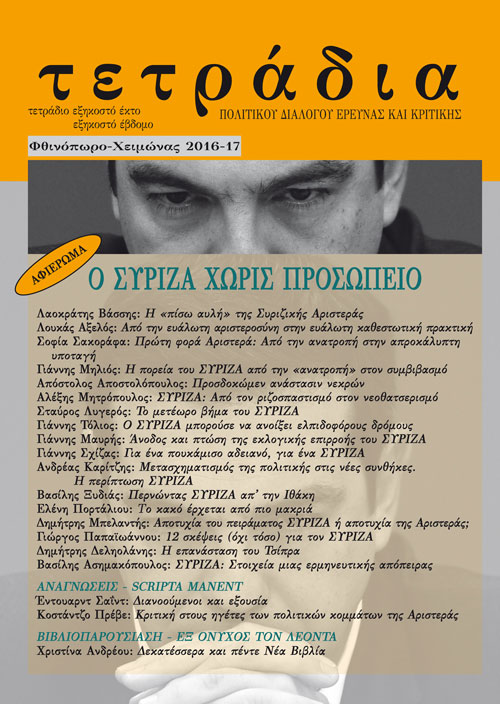
This article was originally published in the political journal Tetradia (of Political Dialogue, Research and Critique), issue 66-67, Fall-Winter 2016-17, pp. 123-132.
That issue carried the general title “SYRIZA Unmasked” and included texts almost exclusively written by former members or close associates of SYRIZA who had withdrawn from the party after its capitulation to the memorandum regime. It is, in this sense, a collection of reflective essays on the failure of SYRIZA.
The article is republished here with only a few additions, made necessary both by the time that has passed since its original publication and by the fact that it has now been translated into English.
Here you can find the original text in PDF.
And here is the publisher’s page presenting the issue.
Πνευματικά δικαιώματα:
Επιτρέπεται η αναδημοσίευση για μη εμπορικούς σκοπούς με προϋπόθεση την αναφορά της πηγής και τη μη αλλοίωση με οποιονδήποτε τρόπο του περιεχομένου. © Basil Xidias

Χωρίς σχόλια