
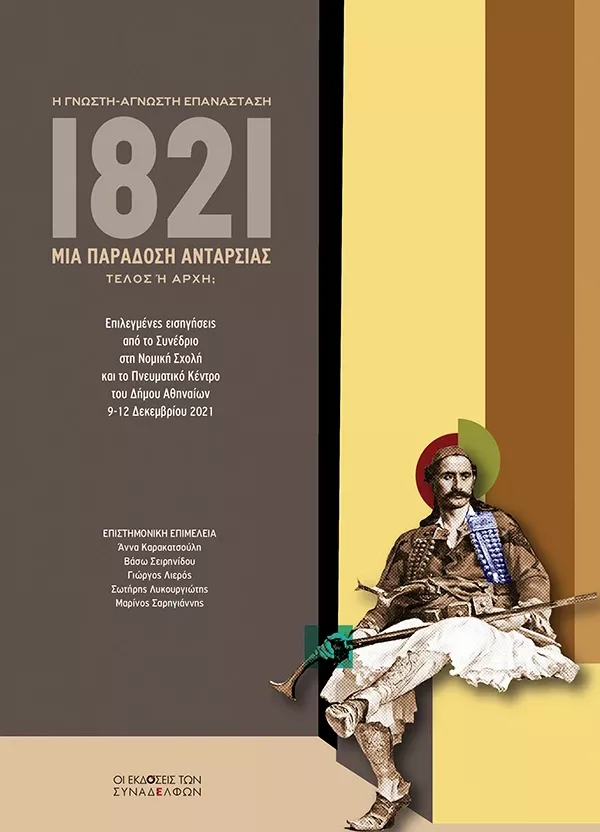
The proceedings of the Conference on 1821 have been published: Tradition of rebellion: The (un)known revolution — an end or a beginning?
q
The book 1821, Tradition of Rebellion: The (un)known revolution — an end or a beginning? (published by Oi Ekdoseis ton Synadelfon, 2025) has been released in Greek. It is a substantial volume of 600 pages, containing 49 of the 74 presentations delivered at the International Congress for the Greek Revolution of 1821, which took place over four days, from 9 to 12 December 2021, at the Athens Law School and the Cultural Centre of the City of Athens. (For further information, see the conference website and its Facebook page.)
The conference, which drew a large audience, brought together Greek and international historians, academics, intellectuals, professional researchers, and political activists. While in one sense it was just one among the many events held in 2021 to mark the bicentenary of the Greek Revolution, it nonetheless stood out for its distinctive character. It operated outside the political and academic frameworks that shaped most other commemorative events—frameworks largely imposed by the government and mainstream media, which more or less sought to present 1821 merely as a prelude to Greece’s eventual accession to the European Union and to what today’s Greek establishment likes to call “the right side of history.”
In contrast to the dominant modernization narrative and the simplistic liberal ideology that accompanies it, the conference aimed to bring to light the neglected or marginalized dimensions of the revolution—those that reflect the multiplicity, complexity, contradictions, and inner tensions that characterize 1821, as they do every true revolution. It also aimed to underline the continuing relevance of these issues today. This intention is reflected in the three elements of the conference’s (and the book’s) title and subtitle: 1821 as a tradition of rebellion — the well-known yet unknown revolution — end or beginning?
For example…
My contribution to the conference was titled “Io. Kokkonis: A communitarian political proposal–theory for the post-revolutionary Greek State” (pp. 434–446). It concerns the two-volume political treatise Peri Politeion (On Polities), written during the decade of the Revolution by Ioannis Kokkonis—a pedagogue, key figure in the Kapodistrian government, later founder of the Society for the Promotion of Education and Learning (Philekpedeftiki Etairia) and of the Arsakeion School, and arguably the first genuinely modern Greek political theorist. As I note in the text included in the volume, Kokkonis’s two-volume political-theoretical treatise “constitutes clear evidence that an alternative path was available” to the course “that things eventually took in the newly liberated Greek state” (p. 435).
A few more details about the conference, from the publisher’s website:
Για την κυρίαρχη ιδεολογία η Επανάσταση του 1821 ήταν «φιλελεύθερη», «εθνική» και «δημοκρατική». Αυτοί οι χαρακτηρισμοί, αν και δεν είναι εντελώς αβάσιμοι, δεν αρκούν για να αποδώσουν την περιπλοκότητα, τις αντιφάσεις, τις αντινομίες και την πολλαπλότητα που χαρακτηρίζουν το 1821, όπως και κάθε πραγματική επανάσταση.
According to dominant ideology, the Revolution of 1821 was “liberal,” “national,” and “democratic.” While there is some truth to these characterizations, they are insufficient to capture the complexity, contradictions, antinomies, and multiplicity that define 1821— just as in every genuine revolution.
This collective volume seeks to offer a panoramic view of the Revolution—one that preserves, as far as possible, the phenomena in all their polysemy and contradictions.
It aims to reveal the distinctness of the Revolution’s multiple layers, agendas, genealogies, and the hybrid nature of the situations it gave rise to.
The very title of the conference points to the two underlying premises on which the volume is based: (a) The Revolution is both well-known and unknown—we know it far less intimately than we do the French or the Russian revolutions. (b) The conference project (and the publication of its proceedings) approaches the Revolution through the lens of a tradition of rebellion—one that predates 1821 and extends into the present.
The conference and the publication of its proceedings constitute an intervention in the public discourse, aiming to contribute to a scientifically grounded critique of the hegemonic ideology. This intervention is oriented toward fostering the social (class) and political consciousness of those actors capable of reviving, within contemporary contexts, the age-old tradition of rebellion.
The full conference program, with all presentations (in both Greek and English), is available here. And here are the detailed contents of the proceedings volume (available in Greek only).
Warm congratulations are due to Giorgos Lieros, who was the initiator and driving force behind both the conference and the publication. Credit is also owed to “Oi Ekdoseis ton Synadelfon” (The Editions of the Colleagues), who brought to completion a demanding publishing project with considerable financial challenges. A particularly effective element proved to be the use of a pre-order voucher, which allowed supporters of the initiative to contribute directly to making the publication a reality.
It is worth noting that the 1821 conference was, in essence, a continuation of a previous conference held in Athens on 12–14 April 2019 on the Russian Revolution of 1917, titled “The Russian Revolution: The Ongoing Challenge.” That earlier conference—organized, once again, by George Lieros and Oi Ekdoseis ton Synadelfon—shared a similar aim: to bring to light the lesser-known or marginalized aspects of the October Revolution. Further material can be found on the conference’s Facebook and YouTube pages, as well as in the volume of proceedings: The Russian Revolution: Critical Approaches to an Ongoing Challenge (Oi Ekdoseis ton Synadelfon, 2021), in Greek.
q
q
Creative Commons License:
Reproduction is permitted for non-commercial purposes, provided that the source is cited and the content is not altered in any way. © Basil Xidias
q

Χωρίς σχόλια